
Imagine a person with complex health needs who wants to continue living in their own home.
Their preference is clear. Their home is familiar. Their community is around them. Their relationships are there. Their routines are established. Their life is there.
But they require high intensity support…. Maybe it’s enteral feeding, catheter management or even a tracheostomy.
Without appropriately trained and competent workers, clear clinical processes, proactive risk management and reliable support systems, remaining at home may become difficult, risky or may feel like an option that is no longer available.
But the answer should not automatically be:
“Your needs are too complex.”
Instead, we should ask:
“What systems, skills and supports do we need to put in place to help this person achieve their goal safely?”
This is at the heart of our approach to clinical governance at Best Care Services.
Clinical governance should enable life, not restrict it
Australia’s social model of disability recognises that people with disability can experience barriers created not only by their impairment, but by the way society, systems and services are structured.
For people with complex care needs, these barriers can be significant.
A person may want to remain living at home, but require specialised support to do so safely. They may want to access their community, maintain relationships, attend church, pursue employment or education, or simply enjoy the everyday activities that give their life meaning.
Complex care needs should not automatically become a reason for those opportunities to disappear.
The right support can help remove barriers.
This is why we believe clinical governance is about much more than policies, procedures and compliance.
It is about creating the systems, capability and confidence that can help people with complex needs live as independently and fully as possible.
Building capability around the person
Our Clinical Governance Framework brings together six key areas: governance and leadership, participant safety, risk and incident management, evaluation and monitoring, safe environments, and workforce capability. Together, these provide the structures that support safe, high-quality and person-centred services, particularly for people requiring high intensity supports.
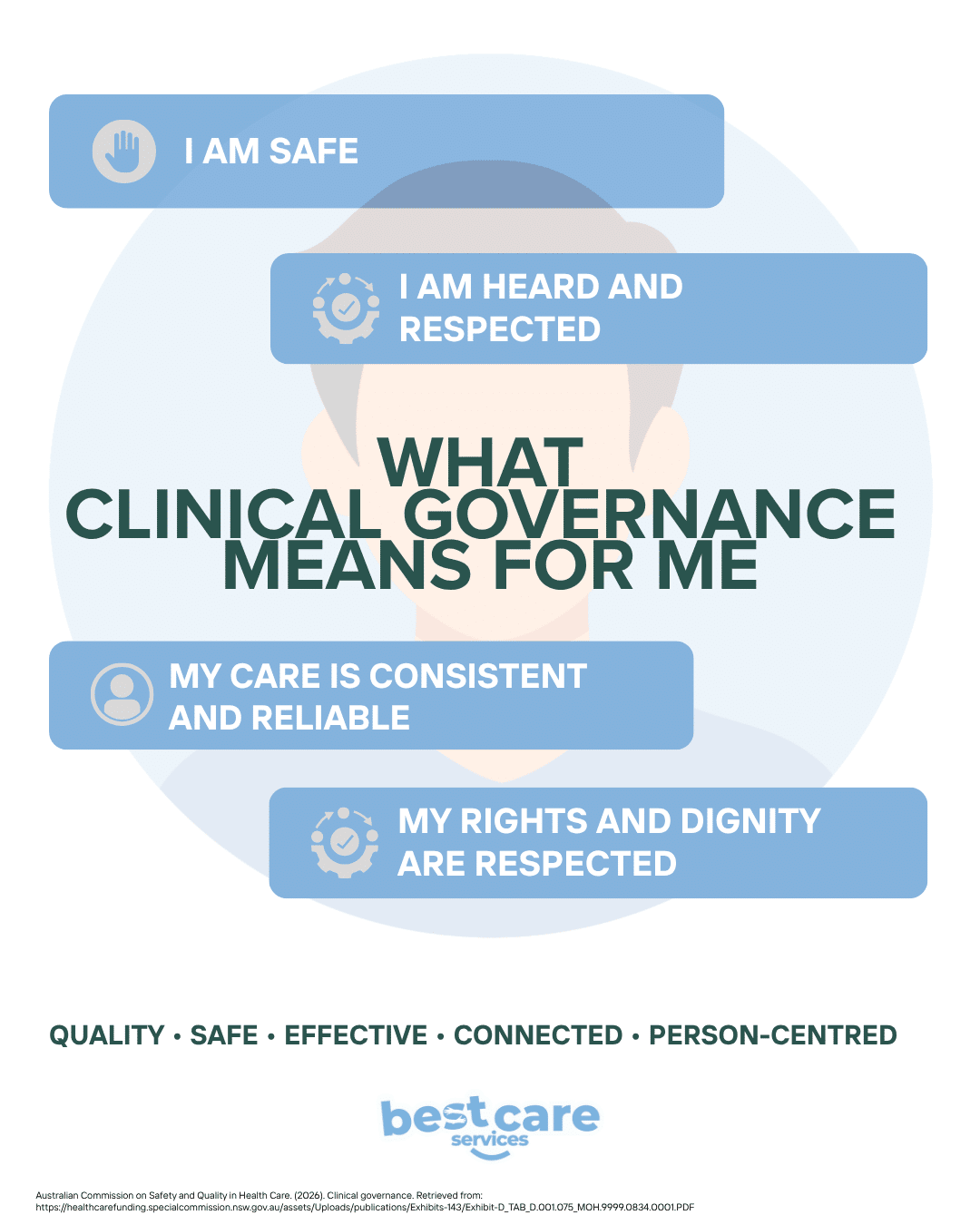
For a participant, this can mean having confidence that the people supporting them are appropriately trained and competent. It means risks are identified and managed proactively. It means changes in health are recognised and escalated appropriately. It means incidents are investigated, lessons are learned and services continuously improve.
Most importantly, it means the person’s goals remain central.
Our framework is grounded in partnering with participants and respecting their rights, preferences, values, culture, goals and choices.
Keeping the world as open as possible
The goal is not to make a person’s world smaller because their needs are complex.
The goal is to build the capability around them so their world can remain as open as possible.
The right support can help a person remain at home. It can help them access their community. It can support greater independence and choice. It can create opportunities for connection and participation. And it can help ensure that a person’s life is not defined by the care they require.
At Best Care Services, we believe clinical governance should not begin with the question:
“What can’t this person do because of their support needs?”
It should begin with:
“What do we need to put around this person so they can do more?”
Because clinical governance, when done well, does more than keep people safe.
It can help make a fuller life possible.
That is why, at Best Care Services, we are committed to building the systems, skills and support around every participant so that complexity does not become a barrier to choice, independence, quality of life, safety, community access or the ability to live at home.
The right support can remove barriers. And every person deserves the opportunity to live a life that is as full, meaningful and connected as possible.